Robert Frost: Great American poet and teller of parables
Published on April 24, 2026
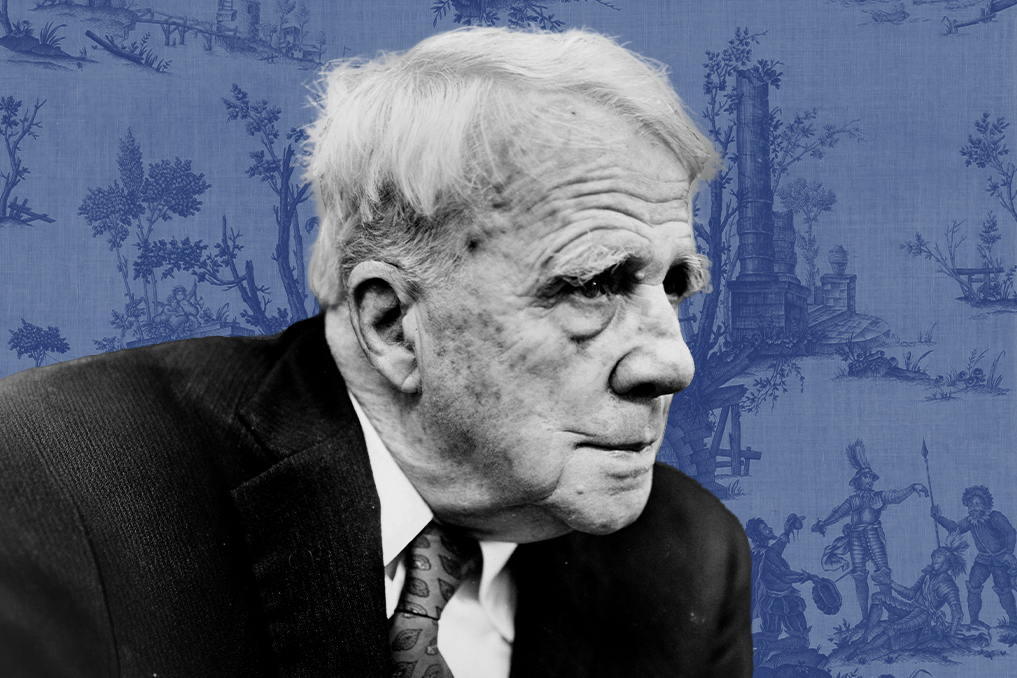
Humanity is constantly telling stories. New friends will trade stories of their lives. Old friends will tell stories that have occurred since they last spoke. For entertainment, we read books and watch movies that are still more kinds of stories. Yet the stories that often best stay with us are those that are trying to tell us something deeper. Humanity calls these stories “parables.” Parables can come in many forms, but Robert Frost was partial to telling his parables as poems. In every Frost poem, there is a parable that reveals something about the human person.

Who is Robert Frost?
Robert Frost was born in California, but moved to Massachusetts in 1884 when he was 10 years old. The move was a kind of return home, as Frost’s ancestors had always been New Englanders. Though he was writing poetry in high school, his first book of poems was not published until he was 40 years old, after which point he won four pulitzers. There hasn’t been a poet since who has been as popular or as loved as Robert Frost.
Frost was a school teacher and worked on a farm in Derry, New Hampshire. His love of New England and his experience working its land and loving its people inspired much of his poetry. He liked to write about nature, about tramps and travelers, about people journeying from one place to another. In the poetic community, Frost was known for going his own way, for failing to ascribe to one poetic movement or another. He wrote what he wanted, and he was good at it.
Frost is often classified as a “nature poet.” However, this only scratches the surface of his poetry. Yes, they include soft quiet scenes such as a snowy wood or an old stone wall. Yes, his imagery is powerful and clearly paints the setting for the reader. However, if one takes the time to discover the parables within his poems, it becomes clear that the “nature” Frost discusses is human nature. His poetry is not simply scenes from nature, but stories of love, loss, longing, and the everyday struggle of being human.

Miles to go before I sleep
Frost’s popular poem “Stopping by Woods on a Snowy Evening” seems at first glance to be a sweet, simple poem appreciating a pretty winter scene. The first two stanzas set up the scene: A man stops his horse to look at a piece of property he does not own as it fills up with fresh snow. A closer look reveals, this is also a parable.
The story is one of temptation and renewed resolve. The traveler stops by woods slightly familiar to him, though they belong to someone else. The traveler is hemmed in by the lake on one side and the trees on the other, and seems tempted to enter the “lovely” woods. The reader is reminded of Dante, who finds himself midway through the journey of his life in a dark wood. The speaker stops, and the horse’s bells question him. Bells often have liturgical connotations, remind the people of God and call them to prayer. These bells act as a warning to the speaker, who wants to enter the seductive woods: “lovely, dark and deep.”
Then the poem turns again, and the speaker says, “but I have promises to keep, and miles to go before I sleep, and miles to go before I sleep.” The speaker will not succumb to the seduction of the dark woods. There is something religious — almost Biblical — about the repetition of the final line. It emphasizes the long journey still ahead of the speaker and seems to solidify his resolve. It is not unlike the final verse of Psalm 90:17: “Let the favor of the Lord our God be upon us, and prosper for us the work of our hands — O prosper the work of our hands!” In this parable-poem, the speaker overcomes temptation, remembers a promise he had made, and continues on his pilgrimage. Frost, through the poem, is encouraging his readers to do likewise.
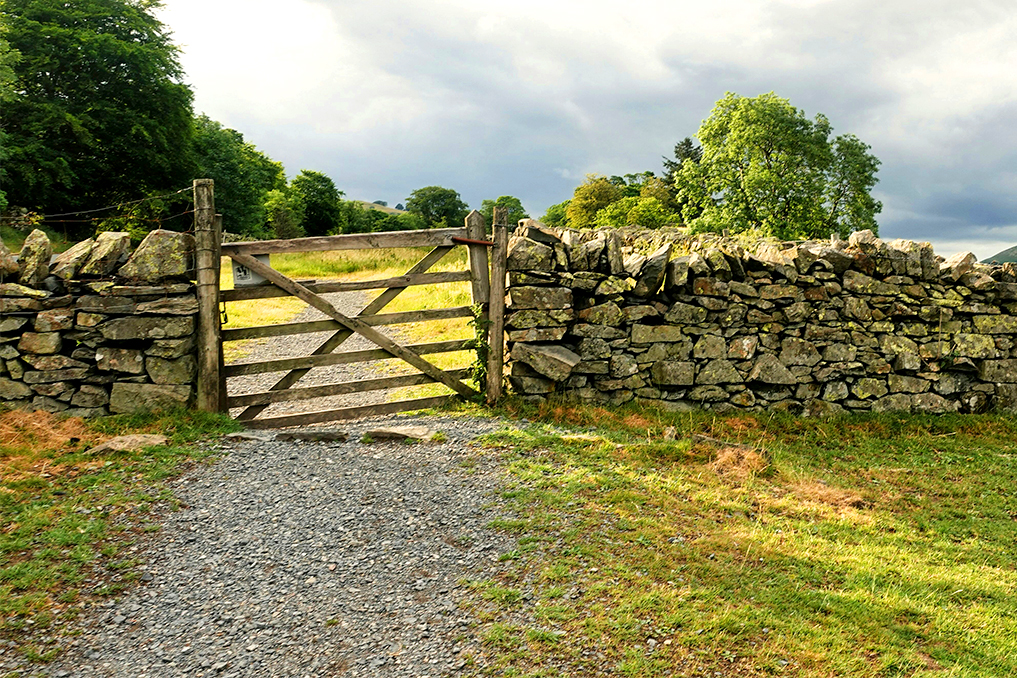
Good fences make good neighbors
Perhaps a lesser known poem, “Mending Wall,” also involves a kind of promise: the agreement between two neighbors to meet and patch their wall every year. Once again, at first glance the poem is fairly simple — the two men walk and work together to patch a wall. Frost’s playful wordplay of his name, the common idiom “good fences make good neighbors,” and the speaker’s cheerful tone initially make the poem seem inconsequential. Yet, once again, there is something in the story that makes the reader pause. The relationship between the two men is the key to the poem, and the mending of the wall between them.
The speaker, who is one of the men, states that “spring is the mischief in me,” and talks about “something there is that doesn’t love a wall,” and “elves” tearing down the stones. The other man, the neighbor, is “like an old-stone savage armed,” who “will not go behind his father’s saying.” The two, one whimsical and the other practical, are united by building something to divide them. The speaker looks forward to fixing the wall, because it brings him together with his neighbor. Fixing the wall is “just another kind of outdoor game,” and the speaker even goes so far as to think the wall unnecessary: “there where it is we do not need the wall: He is all pine and I am apple orchard.” The neighbor, however, is insistent: “good fences make good neighbors.”
Neither man seems satisfied with the wall, the other person, or their mutual relationship. The speaker seems to want more of a dialogue, a friendship, and thus sees the wall as unnecessary in dividing the two men who, though different, cannot harm one another: “my apple trees will never get across and eat the cones under his pines.” Yet to foster that relationship he desires, the speaker must come together and mend the very thing that keeps the two men apart. The neighbor, on the other hand, insists on a division between the two properties and the two men. In order to keep this boundary, however, he must keep up a relationship with the neighbor to mend the wall.
Frost seems to be telling us, in this particular parable-poem, that in all relationships there must be boundaries, compromise, and community. There are going to be differences of opinion and differences of crops grown, but communities thrive when healthy boundaries are combined with cooperation and compromise.
Related Posts
Irish Thunder: Blessed Fulton Sheen and the drama of truth
By William Nardi

5 ways to prep your yard for outdoor fun this fall
By Rose Church

A girl’s guide to shopping for a wearable Miraculous Medal
By Ava Cilento