Should Catholics care about beautiful clothing? Lessons from Clothed with Beauty
Published on April 21, 2026
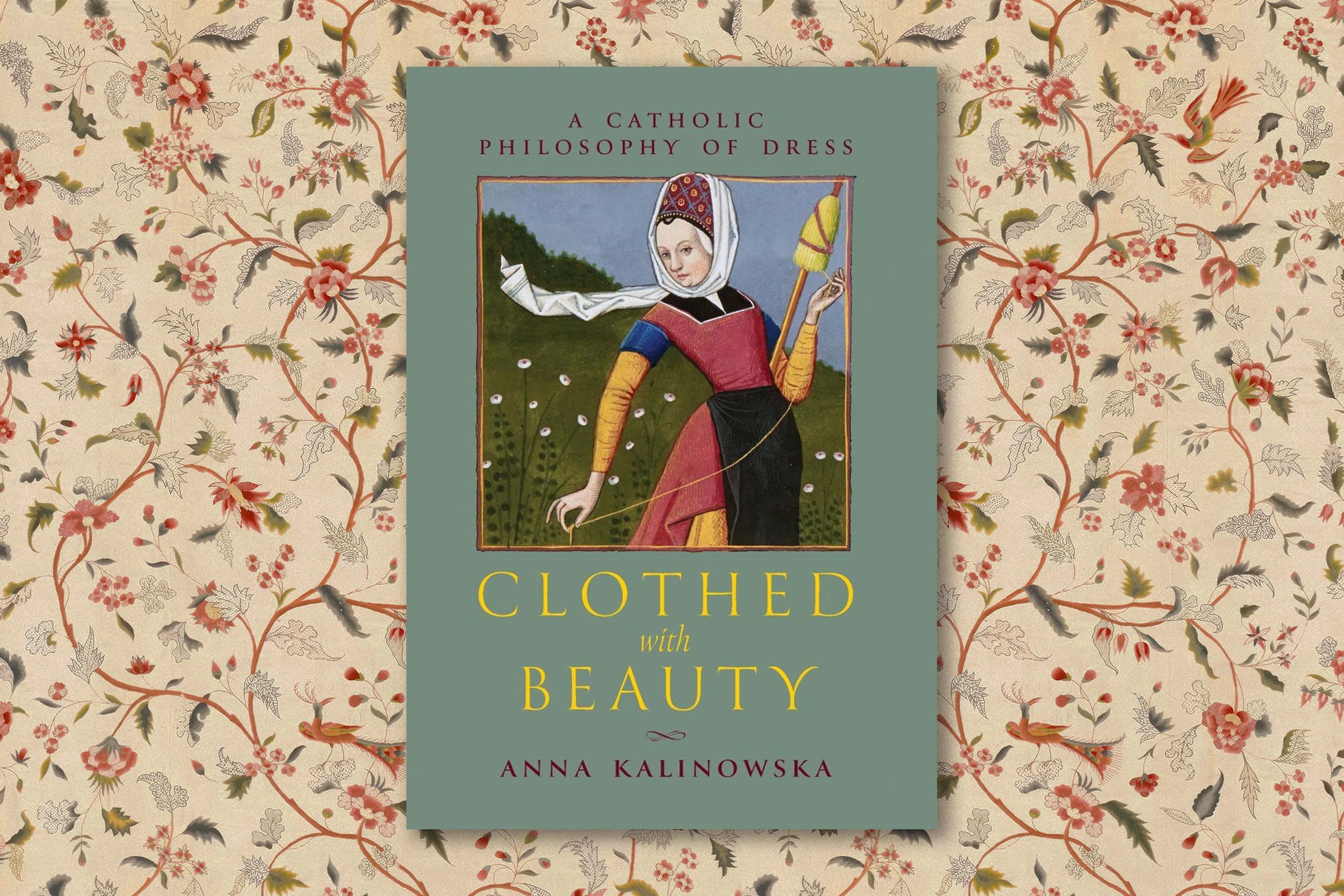
Clothed with Beauty: The Philosophy of Catholic Dress offers one of the first philosophical commentaries on fashion that I have seen on the market. Going far deeper than modesty — though it does touch on it several times — author Anna Kalinowska delves into the questions such as: Why should we dress beautifully, is there an objective measure for beauty, and is it even possible to dress beautifully in the modern world.
Kalinowska begins from the premise that dress is an art. As an art, she explains, it should be rooted in truth (the truth of the Incarnation, the differences between men and women, and the truth of salvation), goodness (especially moral goodness with regards to modesty and chastity), and beauty, grounded in objective, artistic principles. She calls her philosophy of dress the “school of beauty.”
From this point she critiques two common attitudes toward clothing:
- The “school of modesty,” which treats covering the body as the only requirement of dress.
- The “school of normalcy,” which assumes Catholics can adopt modern fashion without discernment.
“As beings made in the image and likeness of God,” she wrote, “we must seek to reflect the all-beautiful God.”
Kalinowska argues that the school of modesty ignores aesthetic beauty, writing that its students “never learn how delightful dress can be and how beautiful its results.” Throughout the books, when discussing artistic principles, she explains why certain modest-wardrobe staples do no justice to the human form.
Kalinowska spends more of her book arguing against the “school of normalcy,” sometimes adopting a caustic tone that could be off-putting to readers who wear casual clothes. She links modern industrialized clothing with the cultural changes that came after the First World War.
“Today’s clothing only reflects the dehumanizing and ultimately diabolical power of industrialism, utilitarianism, rationalism, feminism, and gender ideology,” she writes.
However, Kalinowska does not fully demonstrate the connection between modern clothing and these ideological movements. Without a clearer historical argument showing how specific garments emerged from these ideas, many readers may find the claim difficult to accept.
Artistic dress
I appreciate, though, that Kalinowska spends time going through the art principles that make an outfit beautiful: harmony in texture, color, idea, and shape as well as proportion, balance, rhythm, and emphasis. She uses visuals to show outfits that do and do not achieve these principles, and sometimes offers practical advice on incorporating these principles into one’s outfit.
Beauty vs. elegance
After she goes over the art principles, she spends a chapter distinguishing between elegance and beauty according to philosopher Dietrich von Hildebrand whom she says refers to elegance as “this-wordly” and beauty as “other-wordly.” Kalinowska does not give an exact definition of elegance or beauty (except that they both require the art principles named above) and proceeds by showing examples of each. Beautiful clothing, in her examples, has qualities like fullness, timelessness, grace, and long lines. These are dresses that one could imagine the Blessed Virgin Mary wearing, she writes, and they have a certain transcendent quality. She contrasts these beautiful garments with merely “elegant” dresses, citing some fashion plates from the 1930s as an example.
Using this distinction, she states that the outfits she offers in the chapters on art principles are merely elegant, not beautiful, and she argues that all contemporary clothing lacks beauty.
“By contemporary dress, I mean not only shapeless T-shirts, yoga pants, and ripped jeans,” she wrote, “but also the very best that today’s society can muster. Certainly, we may still find clothing that we find pretty or elegant, but, for an ensemble to deserve the epithet of beauty, it must possess some mark of excellence far above our typical Sunday best, and it is this excellence that virtually all modern clothing lacks.”
Options through the decades
Here is where I take issue with the author: Her analysis seems to overlook several modern styles that attempt to recover beauty in dress. The outfits she offers as elegant options are all rather dated, and are typically recreations of silhouettes from the 1940s and ’50s (which she herself repeatedly states fall short of beauty).
I think there are other silhouettes and outfits available that come at least as close to the ideal of beauty than vintage tea-length dresses. For instance, Kalinowska includes a quote from Hildebrand that admits that the clothing of hippies is often beautiful. The hippies’ iconic Gunne Sax dresses from the 1970s, with their intricate detail and flowing rounded shapes seem to imitate the folk costumes that Kalinowska frequently invokes as an example of beautiful dress – why not examine them? As far as modern options, with the rise of the “cottagecore” aesthetic in the 2020s, alongside other pastoral trends in fashion, there are many dresses on the market that are more beautiful than the fit-and-flare styles of the 1950s.
The book covers several other fascinating topics:
- How the modern man’s suit departs from historical dress for men.
- Why Catholics should prioritize natural fiber.
- Why it is worth spending money on higher-quality clothes.
- Analysis of dresses depicted in classical art.
- Reflections on the clothing of religious orders
Recovering beauty in dress
Overall, despite its limitations, Clothed with Beauty raises questions that Catholics rarely ask about clothing. By treating dress as an art ordered toward beauty, Kalinowska challenges readers to think more seriously about how they present themselves in the world. Even where her arguments are overly pessimistic or historically incomplete, the principles she proposes offer a valuable starting point for recovering beauty in everyday dress.
Related Posts

How JP2 teaches us the concept of healthy leisure
By Ava Cilento
Accessorizing 101: How to mix and match colors and textures
By Jessica Nardi

Custody of the eyes
By Rosie Hall

Sheet Pan Spanish-Inspired Chicken & Chorizo
By Calista Boskus