“The Liturgical Style Guide”: Exclusive interview with author Mary Harper
Published on July 8, 2026
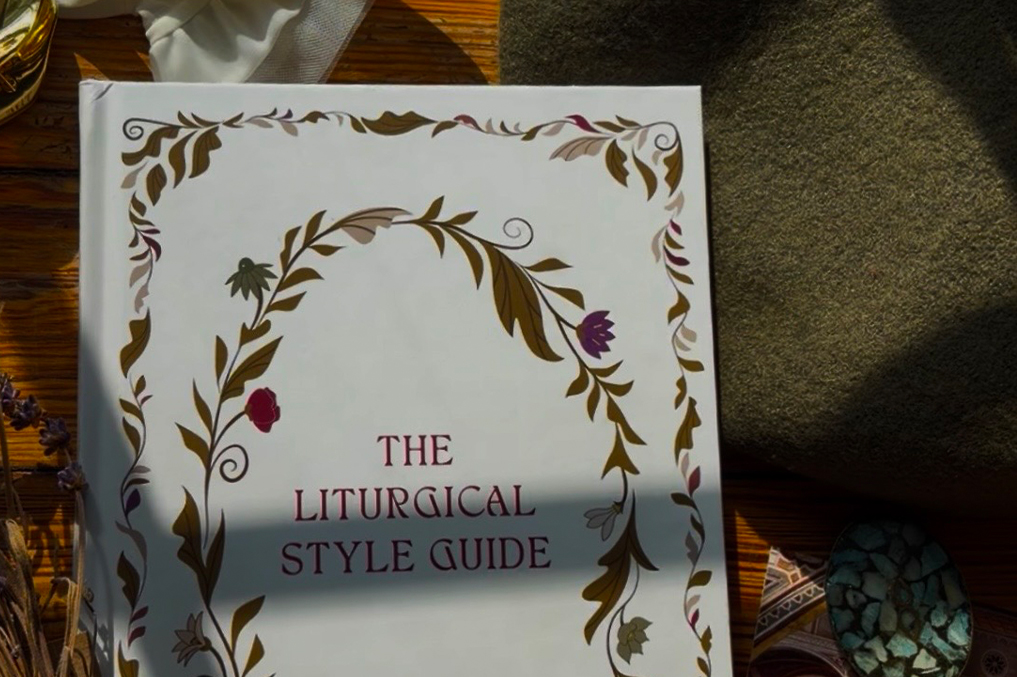
The Liturgical Guide to Style by Mary Harper released this year, views style as a form of prayer and the Church’s liturgical year as the inspiration. When I sat down to chat with Mary Harper about this unique approach to fashion, she explained that her inspiration for this project was her own seeking for God in everything and anything. Just as religious and priests have particular prayers that they say as they don their habit or vest for Mass, Mary Harper wants the laity to make a connection to the Lord in their own morning dressing rituals.
Harper says the significance of clothing and garments is not new, citing several places in Scripture, but her work sheds new light on ways to walk with Christ through the medium of fashion. For example, in Acts of the Apostles we hear of Tabitha, who made beautiful clothing for those who were outcast, and Lydia, the merchant of costly purple cloth. Their conversion examples are reminders that those who worked with textiles had a particular perspective and insight from their occupation that impacted the way in which they received the Gospel.“[Those who worked closely with textiles] were able to take on very quickly the idea of what it looks like to be transformed in Christ because they had watched these fibers, these crops, go through so many processes to become the final product,” Harper said. “They knew it wasn’t a quick or easy conversion, because even their own handiwork was communicating that [being transformed in the Lord] is a slow and careful work.”
“Lydia, with the purple dyed cloth, knew that these fibers had to be carefully combed out and cleaned in order to receive something so beautiful and so holy,” she added. “The purple dye was very expensive, so you couldn’t waste it. You had to be careful of how it was poured out. But once the fibers were made ready, it would seep into everything.”
Beyond the spiritual analogy to textiles, we also see in Scripture and even today that clothing is an external manifestation of an internal disposition. Ripping garments (as seen in Job) is a visible sign of grief, with the fabric being torn apart right over their broken heart. Even today, the tradition of wearing black indicates that one is mourning. It is this very human reality, of communicating what is happening in one’s heart through exterior clothing, that Harper hopes to highlight in her work.

Where to begin?
According to Harper, the best place to start is wherever it feels least intimidating! Give yourself permission to begin with whatever personal style you already have and make small intentional changes. You don’t have to wear full monochrome red on Pentecost to pay homage to the Holy Spirit. A little red ribbon in your hair or red lipstick can be a tasteful and more comfortable choice.
There is meaning and symbolism in color, but even the type of textiles can have a spiritual connection, Harper explained. The breathability and flexibility of cotton is fitting symbolism for docility to the Spirit. Meanwhile, linen which must be beaten and broken over and over to make the fabric can be a symbol of being purified in the Lord and was even required for priests to wear in Leviticus. The fabrics and colors are all opportunities to turn your heart to God by reflecting on His eternal truths.

Can anyone dress liturgically?
Harper says that this approach is for everyone, but it will take very different forms in different seasons and states in life.
“The base level is just inviting Him into your moment of getting dressed and allowing the Holy Spirit to be there,” Harper said. “Even if that’s the postpartum mom who’s putting on the same sweatshirt that has spit up on it, she’s recognizing her vocation in that unlaundered sweatshirt. This is a specific and holy season for her, and she can remember that even through her garments.”
“On the other side, [might be] a fashion student who could tell you down to her earrings, headband, and little ballet flats what Bible verse inspired her outfit,” she added. “Both are amazing!”
Harper emphasized that there is no wrong way to pray with your clothing, but rather it is about encountering God through these garments as yet another touchpoint in your life where you can encounter Him and manifest His love into the world.
Readers can follow along with Mary Harper on Instagram.
The Liturgical Style Guide can be purchased at https://www.liturgicalstyle.com/
Mary’s next book What the Saints Wore is set to release in 2027.
Related Posts

10 Fundamentals that will make you a better home cook
By Calista Boskus


What the Fine Arts Masters can teach about everyday makeup
By Johanna Duncan

Saints abound: Liturgical living in October
By Lindsey Fedyk