Soot, sawdust, and sanctification: Exclusive look inside the College of St. Joseph the Worker’s bold higher ed experiment
Published on October 18, 2026
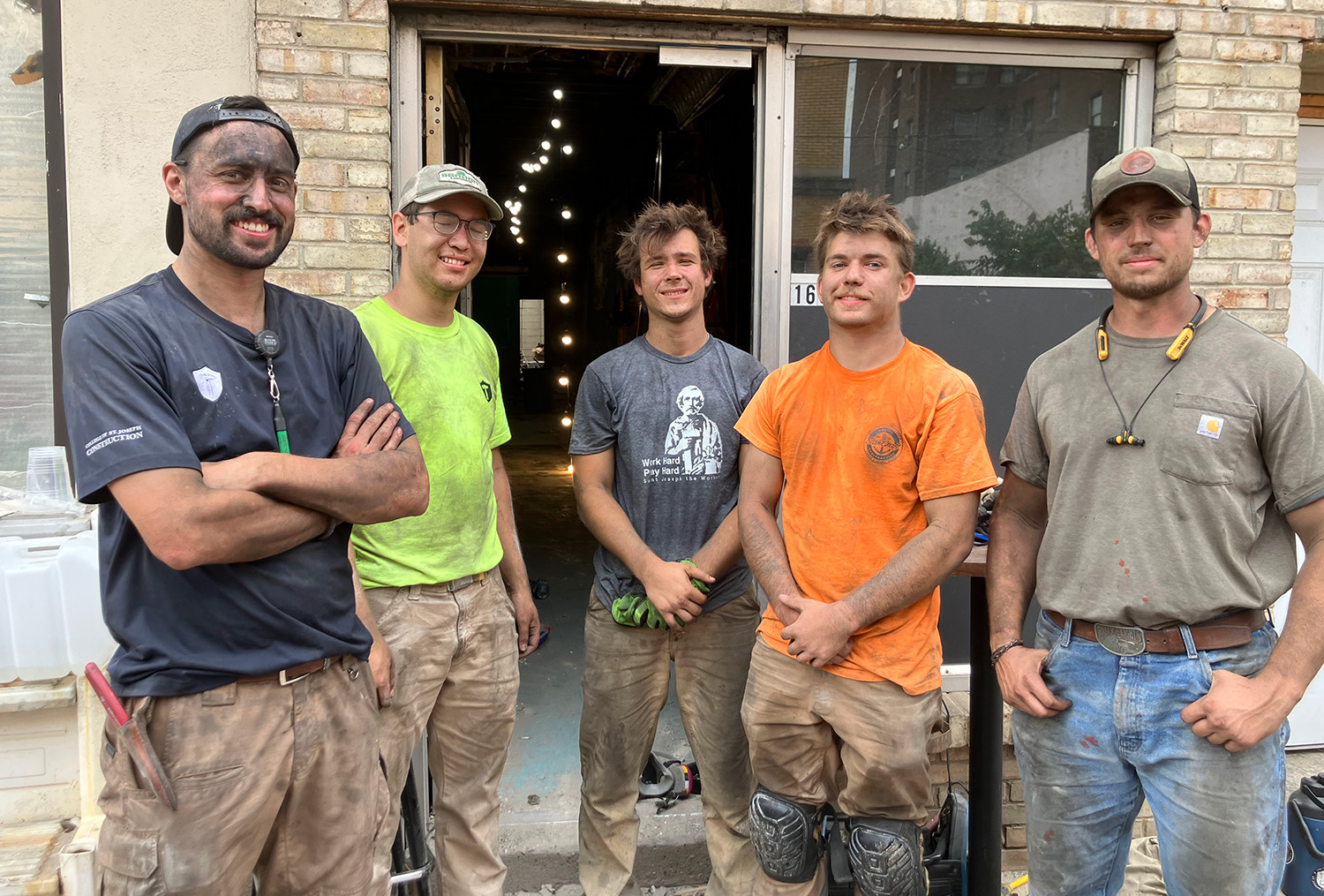
When Patrick “Paddy” and Adam walked through the front door of Leonardo’s Coffeehouse in downtown Steubenville, Ohio, they looked less like college undergraduates and more like Victorian chimney sweeps.
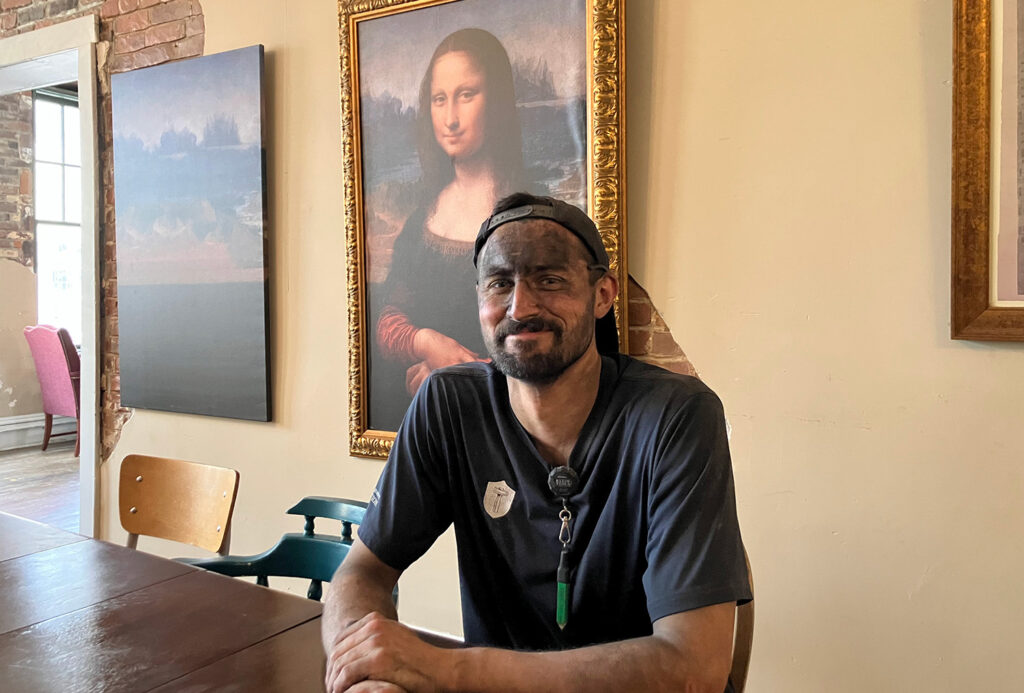
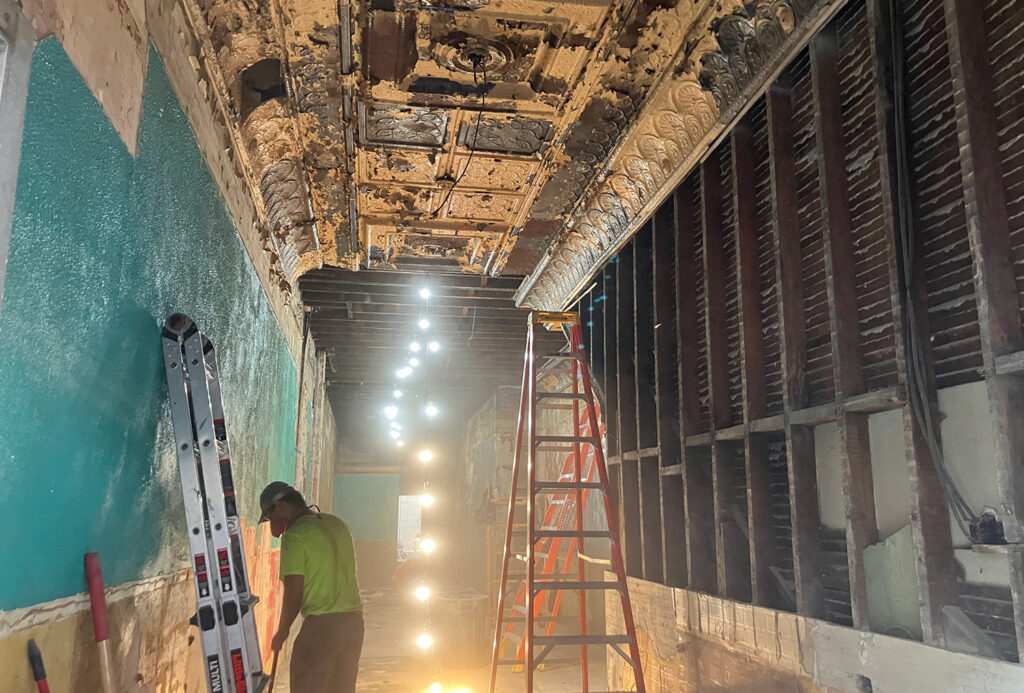
Their faces and forearms were streaked with dark soot, and despite a long morning on site, they walked with a spring in their step. I learned the layer of grime wasn’t their daily dress code; they had spent the morning just two doors down repairing an early 1900s vaulted ceiling, catching a plume of century-old dust right before our interview. The barista greeted Paddy with friendly banter as they ordered, noting his unusual appearance. Paddy, 33, a native Austrian who spent years working in Ireland before arriving in eastern Ohio, wore a broad grin that cut through the mess. Adam, 22, a former college music student turned plumber, laughed as they headed upstairs.
Upstairs on the mezzanine, Paddy settles into a leather chair at a table directly beneath a full-scale reproduction of the Mona Lisa. At the other side, Adam sits with wall sketches of Leonardo da Vinci’s flying machine in the background.
The juxtaposition is striking, almost humorous, but it captures the essence of the College of St. Joseph the Worker (CSJW) far better than any admissions brochure.
For generations, American higher education has operated on a strict division: The intellectual class goes to universities to read academic texts and enters the office job economy; the working class heads to vocational trade schools or union halls. The mind is separated from the hands. One side takes on crippling five-figure debt for abstract credentialing; the other masters physical mechanics often divorced from philosophical or spiritual formation.
Here, in the rugged Rust Belt basin of the upper Ohio River Valley, St. Joseph the Worker is staging a counter-revolution. Now in its third operational year as a state-authorized degree-granting institution, the school promises something that sounds like an impossible marketing slogan: mastery of an accredited skilled trade, a bachelor’s degree in Catholic Studies, and zero debt upon graduation.
Is it a utopian concept, or is it actually working? I traveled to Steubenville to find out.
Rebuilding the ruins of Steubenville
A few years ago, when I used to visit my future wife while she was an undergraduate at Franciscan University of Steubenville, downtown revitalization efforts were just beginning to stir. Like many historic manufacturing hubs along the Ohio River, decades of shuttered mills had left behind empty storefronts, crumbling brick façades, and streets where you checked over your shoulder before walking to your car.
Today, CSJW is actively amplifying that downtown momentum. The energy on North 4th Street has palpably shifted. Young men in dusty Carhartts and work boots walk between job sites, greeting local shop owners by name.
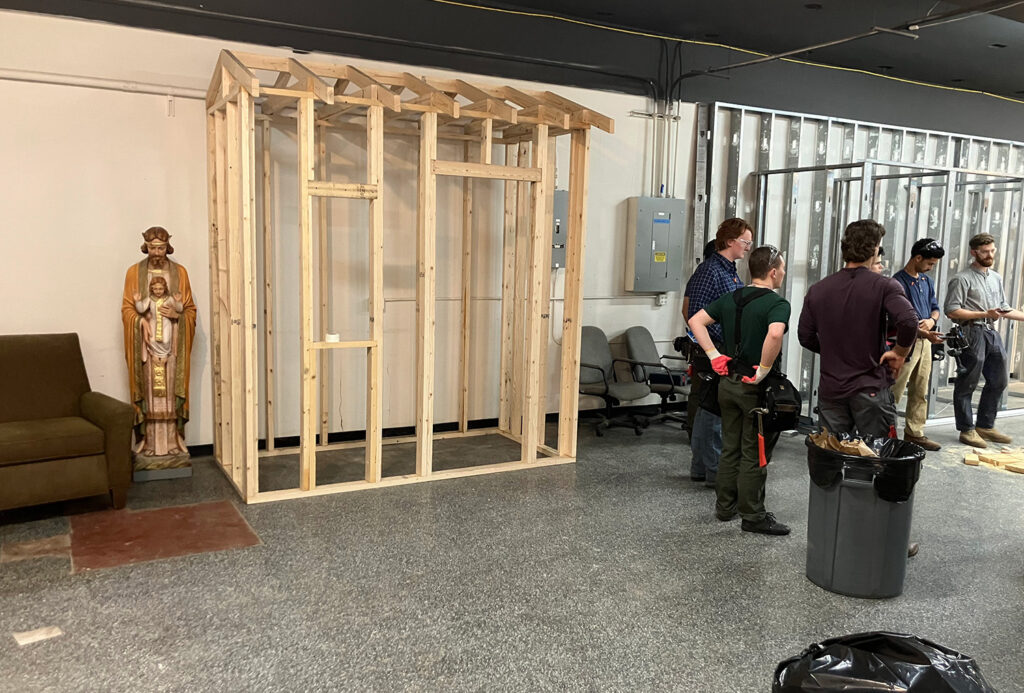
Just two doors down from Leonardo’s is where these CSJW students are gutting and restoring a historic storefront. Stepping inside, the vast space is illuminated by long strands of what seemed like construction grade dorm lights. Yet this crew is not doing a class simulation; they are executing a real, full-blown rehabilitation.
A short walk through downtown reveals what Michael Gugala, the college’s vice president of admissions, calls a campus triangle across the city grid.
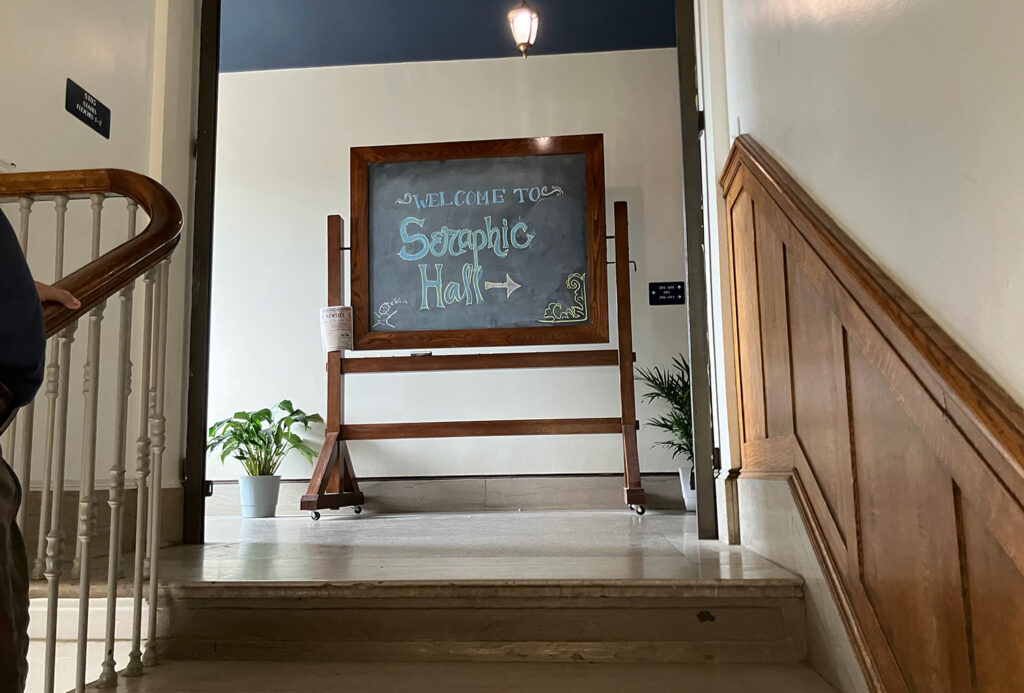
The college has deliberately avoided building an isolated campus. Instead, it has woven itself directly into the streets. There is the trade building, packed with industrial jointers, table saws, and a dedicated lumber bay so students don’t have to drive an hour to a commercial mill. Across the street sits a repurposed former federal building, once a bustling downtown post office and courthouse, now serving as the primary academic hall.
Inside the old federal building, classrooms are identified not by room numbers, but by the timber used inside: Students take theology lectures in the “Hickory Room,” sitting at handcrafted desks they built over the summer. Down the hall, the faculty lounge occupies the old U.S. Marshal’s office, complete with its original, heavy-iron holding cell — a visual joke not lost on the professors debating medieval scholasticism inside. In an adjoining room, a choir of local neighborhood children rehearses hymns, using classroom space the college freely shares with the community.
The physical footprint continues to expand: The college is under contract to acquire Steubenville’s Masonic Temple, with plans to have the building formally exorcised and consecrated into lecture halls, student spaces, and a chapel.
Crucially, the students’ manual labor is not performative. To satisfy state legal requirements for registered apprenticeships, the college founded its own non-profit construction company.
“Via the construction company, we’re able to have our students be employees and get paid,” Gugala explains.
Last year alone, student crews built three houses: two private residences — including a complex timber-frame home — and a single-family transitional home built in collaboration with the Jefferson County Metro Housing Authority.
“The goal there is to take a single mother and her kids out of government high-rises and place them in a real house in a real neighborhood, giving them a foundation to get back on their feet,” Gugala says. “Our students built that.”
The commercial footprint continues to push outward. This past summer, the school launched Joe’s Better Plumbing, a fully operational service company whose branded trucks now respond to residential calls across the valley. Meanwhile, across state lines, the college recently purchased acreage in West Virginia, where student crews will break ground on a new housing development.
Yet despite surging national interest, the college’s footprint remains intentionally tight.
“Our acceptance rate right now is 27%,” Gugala notes, admitting cohorts of roughly 30 to 35 students per year out of a deep applicant pool. The ceiling is dictated partly by student housing, but even more so by apprentice safety ratios: Under state apprenticeship rules, the college maintains a strict five-to-one student-to-instructor ratio on job sites to ensure rigorous safety and direct personal mentorship.
The Arithmetic of “$0 Debt”
The promise of graduating debt-free is the magnet drawing applications from across the country. But how does the math actually hold up?
On its website, CSJW lays out a transparent breakdown of costs, pairing its flat $15,000 annual tuition with $860 in standard institutional fees — specifically a student life fee of $500/yr and a modest monthly residential maintenance fee of $40/mo (over 9 months). Rent-free housing is available for most students in college-owned houses, and because the school operates without administrative bloat or compulsory dining plans, the line items reflect practical living rather than inflated campus overhead.
Crucially, the college also publishes projected apprenticeship earnings that outpace direct tuition and fees in later years, climbing from $16,720 in Year 2 up to $22,480 by Year 4. On paper, those wages fully overtake the $15,860 annual institutional bill.
Yet on the ground, the financial arithmetic still requires clear-eyed budgeting for everyday expenses.
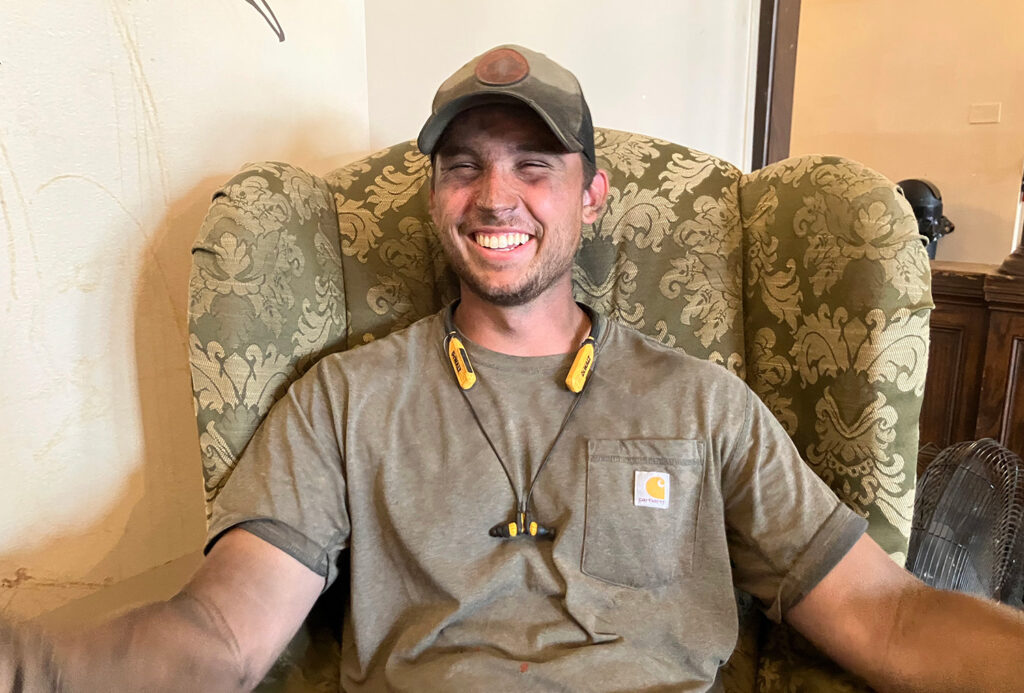
“People shouldn’t just think $15K and that’s it,” Paddy tells me bluntly over coffee. “In terms of tuition, yes, it’s $15K. But you need food. There’s no dining hall here. You need fuel, you need tools, you have car insurance, and you have books. You should come with the expectation of needing $20,000 a year.”
The primary hurdle is Year 1. During their freshman year, students are in a “pre-apprenticeship” survey track, rotating through carpentry, HVAC, plumbing, and electrical basics alongside full academic coursework. Because they are not yet legally registered apprentices, their shop hours are unpaid.
That means Year 1 must be funded upfront. While some students rely on family support, others prepare well in advance.
“I worked and saved up around $12,000 to $13,000 before I came,” Paddy says. “My advice to anyone looking at this school: Take a gap year. Work a job, make some money, get your spiritual life in order, and build a cushion.”
By Year 2, the financial model kicks into gear. Students select a specific trade concentration, enter their official registered apprenticeships, and begin drawing a regular paycheck through the college’s non-profit construction company. Combined with private merit scholarships — such as the $5,000 annual grant Paddy secured through the Foster’s Outriders program — those escalating apprenticeship wages allow students to comfortably cash-flow the rest of their degree.
The students work hard, but they leave with zero student loans, several thousand certified apprentice hours, and trade tools they own outright.
Castles, brick arches, and the end of “extended adolescence”
For generations, the standard university experience has drifted toward what Gugala terms an “extended adolescence” — four years of unstructured afternoons, high tuition, and campus distraction with minimal accountability. At St. Joseph the Worker, the day is scheduled from 8 a.m. to 5 p.m., split between morning academic seminars and afternoon trades.
The administration rejects the idea that trade work is merely a fallback for students who couldn’t cut it in the academy. The student body is intellectually ambitious, with several students considering future careers in academia, law, or parochial education.
“We have students who want to be professors, teachers, or farmers,” Gugala notes. “Having a trade changes everything. You have a skill that pays your way through graduate school or supplements your income and makes your family a little more comfortable so you can teach. Once you have a trade, it’s yours. It can’t be offshored, and it’s not going to be AI’d out of you.”
That commitment to durability also drives the college’s newly established Traditional Building Track. This splits from a general tract for building things like shelving and focuses on building structures. Rather than merely training students in the rapid methods of modern housing, the traditional track revives methods rooted in classical architecture that build structures that last.
The vision has already established international roots. This past year, a cohort of students traveled to Austria to work on the ancestral estate of Austrian Catholic nobleman Baron von Tschugguel, training directly under European master craftsmen (Meister). Surrounded by stone masonry and timber framing that have endured for half a millennium, the students studied restoration techniques that have largely vanished from standard American construction sites.
“The building industry shifted toward quick production, cheap materials, and churning out houses that fall apart in a generation,” Gugala explains. “Our goal isn’t just to build as many houses as possible. It’s to ask: What is the most beautiful, durable way to build? How do we build structures that last for hundreds of years, and how do we make that craftsmanship accessible?”
What is competence for?
Still, for many parents, an obvious question lingers: If a young Catholic man simply wants to learn plumbing, electrical, or carpentry, why spend four years in Steubenville taking theology and philosophy courses? Why not just join a local trade union for free?
When I posed this question to college co-founder Dr. Jacob Imam, his answer was direct.
“A trade school can make your son competent. It cannot tell him what his competence is for,” Imam told me. “A young man with a plumbing license and no formation is a man with real power and no account of how to use it — over his money, his time, his household, his employees. Our Catholic Studies curriculum exists to answer the questions the trade cannot: What is a man? What is a household, and how is it governed? What is money actually for, and why has usury been condemned by every Christian century but ours? What do you owe the town you live in?”
For Imam, the Catholic Studies major is not an abstract academic exercise; it’s the essential prerequisite for Christian leadership in the secular world.
“The aim of the Catholic Studies education is to form the lay mind with his purpose, which is to do no less than to sanctify the temporal order,” Imam says. “The Church has commanded us to sanctify home life, economics, and politics. That is the job of the laity. But we cannot sanctify anything if we do not first think with the mind of the Church… And no — it isn’t abstract lecture halls. Our students argue about Aristotle with grout under their fingernails.”
The Forge of the Job Site
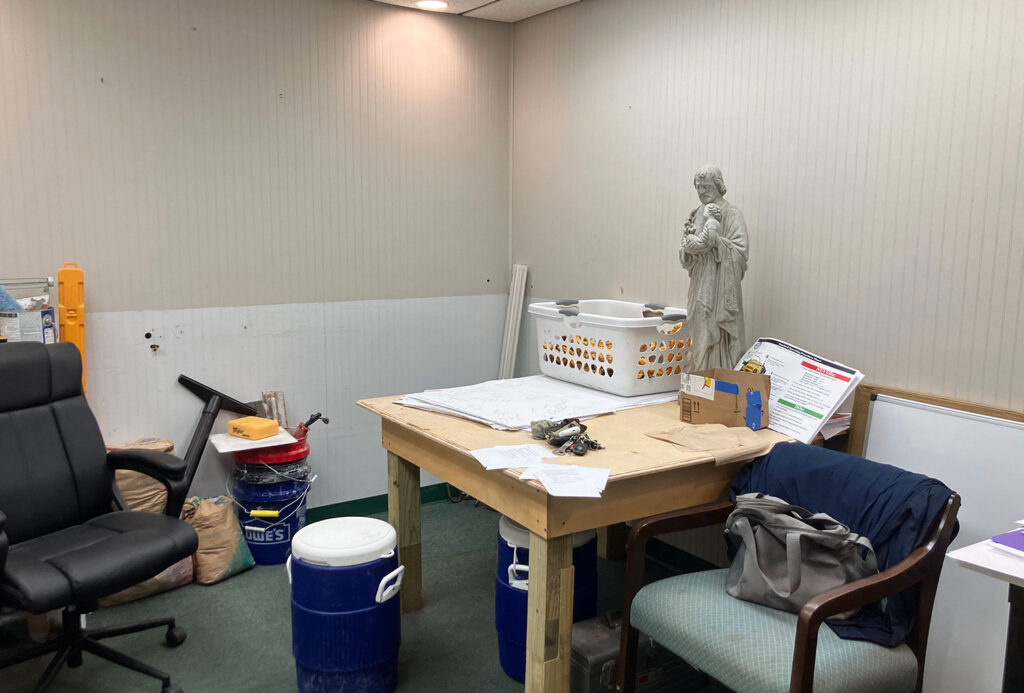
That fusion of intellect and muscle is tested daily on the job site. Inside the workshops, statues of St. Joseph stand above rows of construction equipment, sanctifying the space.
“We have a day that is ordered by prayer, and everything else is fitted into it,” Imam explains. “But the more important answer is that the formation doesn’t stop when they leave the chapel. Our students spend their afternoons on scaffolding, in trenches, in mechanical rooms — with masters and journeymen who are also their formators. A young man learns patience because a joint doesn’t care about his mood. He learns obedience because the foreman is right, and he isn’t. He learns charity because he’s tired, his partner is tired, and the work still has to be finished well for whomever the job is for. Those are the same virtues the Summa describes; our students meet these virtues in reality alongside the book. St. Benedict didn’t separate ora from labora with a hyphen by accident. Neither do we.”
Sitting with Paddy and Adam, it becomes obvious that this physical reality acts as an unsparing mirror, confronting each man with his specific weaknesses.
For Adam, who spent his early college years focused on sacred music and youth ministry at Annunciation Heights camp in Colorado, construction job sites were comparatively rougher around the edges.
“With the plumbing crew, I had to toughen up a lot,” Adam admits. “The guys on job sites can be rough around the edges. In order to get through, I had to learn how to brush things off, but also how to handle confrontation. I had to learn to say, ‘Hey dude, shut up. You’re doing this wrong, and this is how we’re going to do it.’ In construction, if you don’t speak up, a pipe bursts or someone gets hurt. I had to learn that it’s okay to be tough and assertive, as long as it’s done with charity.”
For Paddy, the journey was the reverse.
Before coming to Steubenville, Paddy spent seven years in corporate tech sales in Dublin, working for firms like Apple and Japanese cybersecurity company Trend Micro.
“Modern corporate office culture is full of company politics, middle management, and beating around the bush,” Paddy reflects. “I reached a point where I just wanted an environment with raw honesty. But coming from that background, my default is to be blunt and confrontational.”
Paddy chose traditional carpentry — focused on timber framing, hand-chiseled joinery, and fine woodworking. The confident, yet charitable communication styles of the master tradesmen in this discipline speak to him on a deeper level as an area he’s growing in.
“I needed to learn how to quiet it down, which is to have prudence,” Paddy says.
One man needed fortitude; the other needed more restraint. Both found it walking a path from different directions that ultimately led to an unassuming carpenter from Nazareth.
Liturgy, cigars, and Newsies
There is a temptation among outside observers to cast the student body into neat caricatures: either reactionary culture warriors retreating into an enclave, or simple laborers uninterested in higher things. Neither label holds up.
The campus culture avoids the bitter factionalism that often plagues contemporary Catholic discourse. Daily Mass and perpetual adoration take place just down the street at St. Peter’s Church. On Sundays, students scatter across the valley according to their liturgical preferences: Some assist at the Traditional Latin Mass downtown; others drive north for Byzantine-Melkite Divine Liturgy; still others attend reverent Novus Ordo Masses in nearby Wellsburg, West Virginia, where CSJW students volunteered their weekend to tear out deteriorating carpet and uncover the historic sanctuary tile for a local parish priest, with plans to assist on further church repairs this fall.
Spiritual direction on campus is also available. Confessions are heard by visiting priests like Fr. Andrew Dalton, LC — a globally recognized scholar on the Shroud of Turin — who is known among the students for calling them higher.
When the workday ends, the intellectual life does not evaporate. The students frequently gather at Chesterton & Co. Cigars downtown, pairing smoke with spirited debriefs of the philosophical texts they read that day. Other evenings, they head up the hill to Franciscan Square’s Harp & Habit pub for discounted wing nights.
On the administrative side, while there’s no formal academic relationship between nearby Franciscan University and CSJW, Gugala hopes to see a mutually beneficial relationship form. An earlier informal connection — a Franciscan student woodworking club that utilized CSJW’s shop bays — faded out after the club’s student founder graduated. Gugala hopes to see renewed bridges form, noting that both schools have serious scholars and faculty who would benefit greatly from an ongoing relationship.
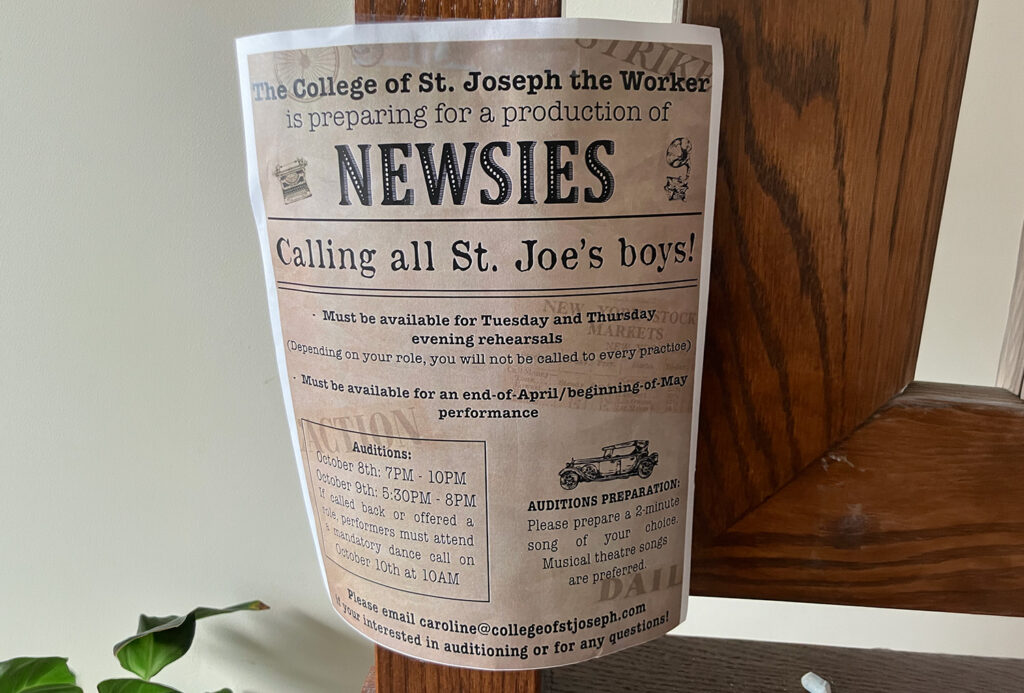
CSJW students, on the other hand, are currently involved in a different kind of extracurricular activity. Defying every tradesman stereotype, several students trace their initial love of woodworking back to building stage sets for high school theater. That creative energy carries over into campus life today: CSJW students are currently staging their own student-run production of the musical Newsies.
Hands, minds, and the call to parents
As our conversation at Leonardo’s wound down, Paddy paused to reflect on what this unconventional education means for the Church at large.
“A lot of people today think that for the laity to be holy, we have to start taking over things that belong to priests or religious,” Paddy said. “The tradition of the Church says the opposite: The laity has its own distinct secular vocation to sanctify the world. What does the laity have? We have hands. And we’ve got a brain. And we need to use both.”
For CSJW students, this means careful cultivation of hands and minds, but that’s far from uniform.
“The professors here openly disagree with each other on big ideas, and they don’t hide it,” Paddy says. “We’re not being funneled into an echo chamber.… We have study groups where the guys who are good at math tutor the guys who struggle, and the guys who know carpentry coach the academics on the job site. We all get through it together.”
When I asked Dr. Imam what he would say to parents who are hesitant to send their high school seniors into this uncharted hybrid model, his challenge cut straight through modern educational dogma.
“Reject the choice you’ve been handed between faith and finances; between cultivating the Catholic mind and preparing for a good career,” Imam said. “The head and the hands ought to be trained together. The dichotomy is a marketing artifact of an industry that needs you to believe it. Prestige emerges not from an institutional background, but from what you actually do…. Talk to our students without me in the room. Watch them at Mass and watch them on a job site. Most parents who do so start to understand the benefit the college has on offer.”
Having sat with those students — without university staff, laughing beneath the Mona Lisa with construction dust clinging to their hair — it is impossible not to see institutional promises kept and God at work.
The College of St. Joseph the Worker is not an easy road. It demands up to 50-hour weeks of physical labor, domestic self-sufficiency, and unsparing intellectual discipline. It is not built for those seeking an extended adolescence.
Yet for Catholic families watching higher education struggle under ideological decay and unpayable debt, Steubenville offers an alternative that is physically and spiritually grounded. In an age characterized by screen fatigue, economic anxiety, and cultural drift, St. Joseph the Worker is proving that true education does not pull young men out of reality. It puts a hammer in their hands, the Summa on their desks, and sends them out to rebuild the world.
Related Posts

Faithfully fall: Embrace the season in your domestic church
By Jessica Nardi


The accidental apostolate of the Furys
By Johanna Duncan

14 fall date ideas that don’t involve the apple orchard
By Ava Cilento