Bishop Sheen: Beatified in prime time
Published on September 18, 2026
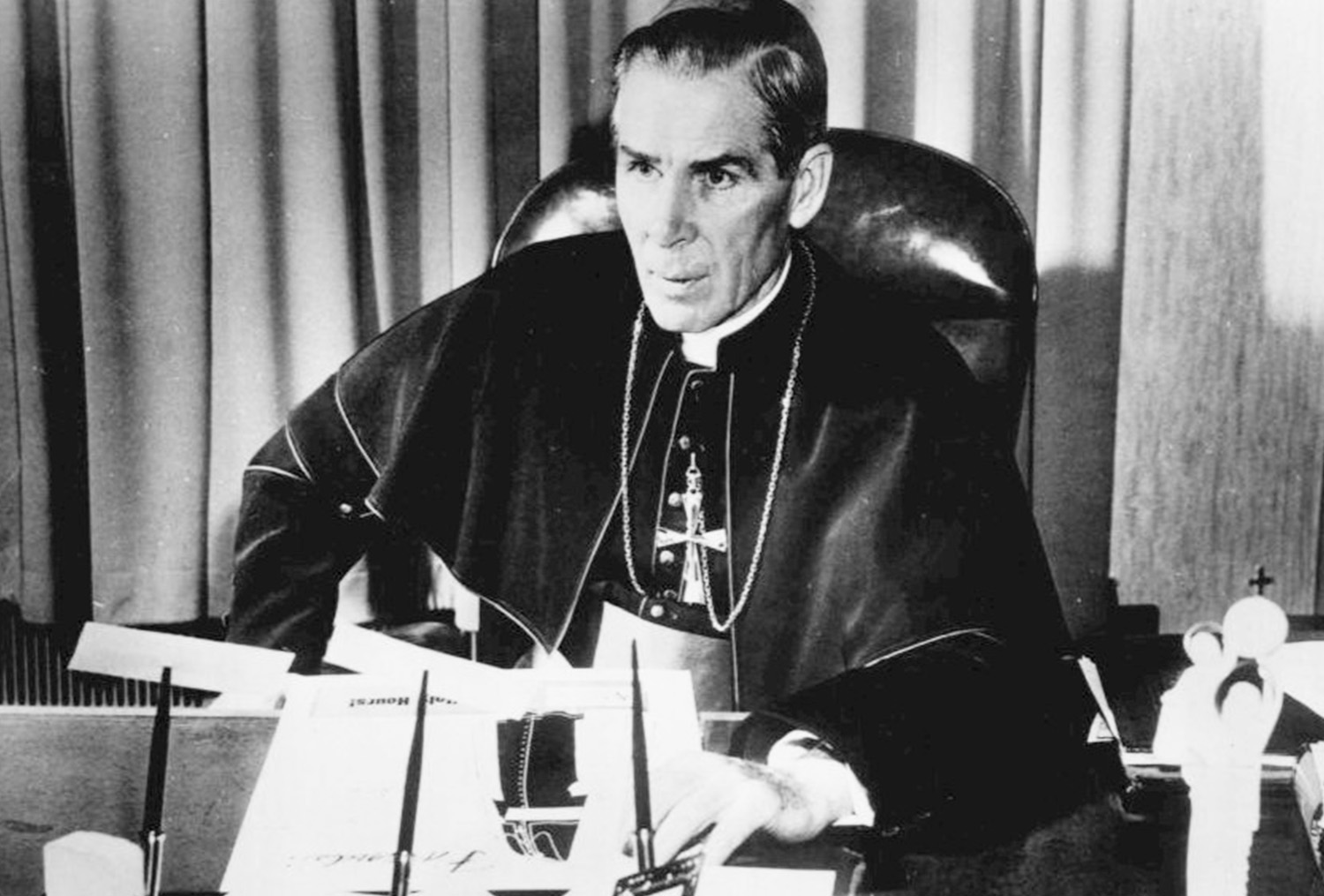
There is a small detail from the set of Archbishop Fulton Sheen’s award-winning television show Life Is Worth Living that perfectly demonstrates his deep understanding of the medium he was using. The only prop was a chalkboard. When Sheen filled it, an unseen stagehand would step in and erase it. Sheen called the stagehand his “angel.” The point was continuity, so Sheen’s eyes never had to leave the camera to manage the machinery of the broadcast. The technology was handled so smoothly that the audience could remain captivated by Sheen’s words. This simplicity kept the show focused on the message, and the man delivering it, who was looking directly at you, making a personal connection that transcended the TV screen.
That arrangement more clearly demonstrates Sheen’s genius than his ratings or his Emmy, though both are impressive. His gift was that he understood, earlier and more completely than almost anyone else of his era, what a mass medium is actually for. Sheen walked so Fr. Mike Schmitz, Fr. Dan Reehil, Bishop Robert Barron, and many others could now run, touching millions of souls through screens.

The pioneer before the television bishop
It’s tempting to start the Sheen story with Life Is Worth Living, but that is not where his story starts. Before his TV debut, Sheen had already spent 20 years building an audience on radio. From 1930 to 1950, he hosted The Catholic Hour on NBC, reaching a peak of roughly four million listeners. Unafraid of controversy, Sheen tackled communism, racism, and American values with deep intellectual seriousness, refusing to “talk down” to his audience.
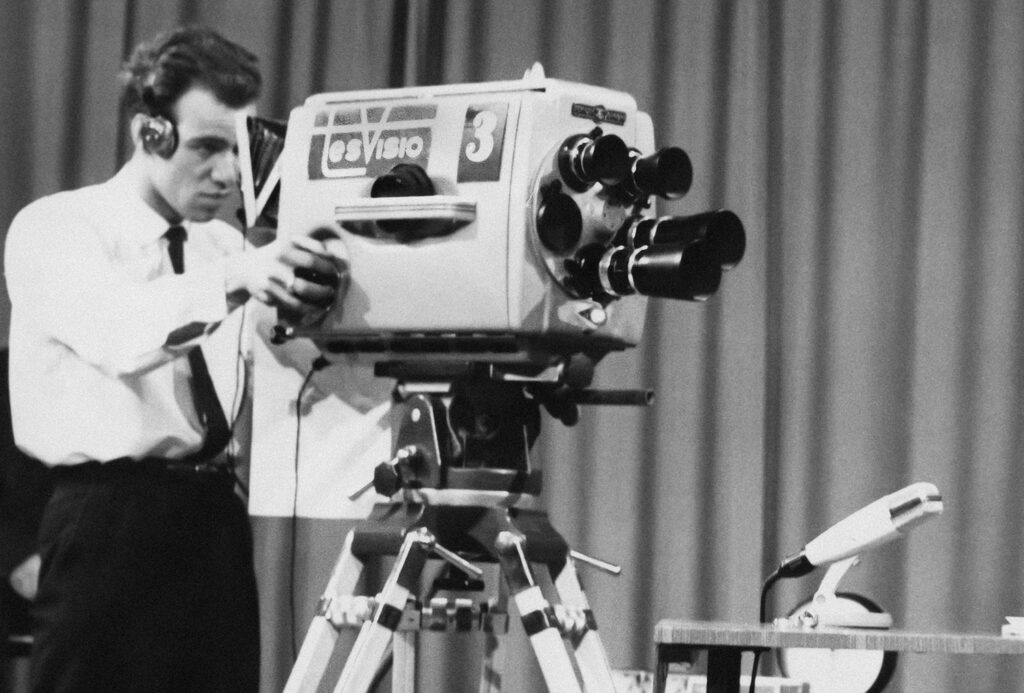
By the time Life Is Worth Living premiered in 1952, Sheen was an experienced communicator, having mastered this skill against real competition, as his show aired opposite Milton Berle, and later Frank Sinatra’s time slot. Still, Sheen could draw as many as 30 million viewers a week, most of them not Catholic, earning him an Emmy for Most Outstanding Television Personality.
Mastering the tool without becoming its servant
Sheen spoke every week with no script, no cue cards, and no teleprompter. Instead, his remarkable spontaneity was a product of spending the better part of each week rewriting the same 20 minute lecture until he knew it by heart. What audiences experienced as effortless directness was the product of intense private labor, done so that what appeared in public could be smooth to the eyes, ears, and hearts of everyone in the audience.
Sheen’s success as a minister-turned-media-personality was based on hard work and talent. Rather than allowing technology to mold the messenger or the message, Sheen learned total command of the technology so as to put it entirely in service of the Gospel.
The love that made the truth land
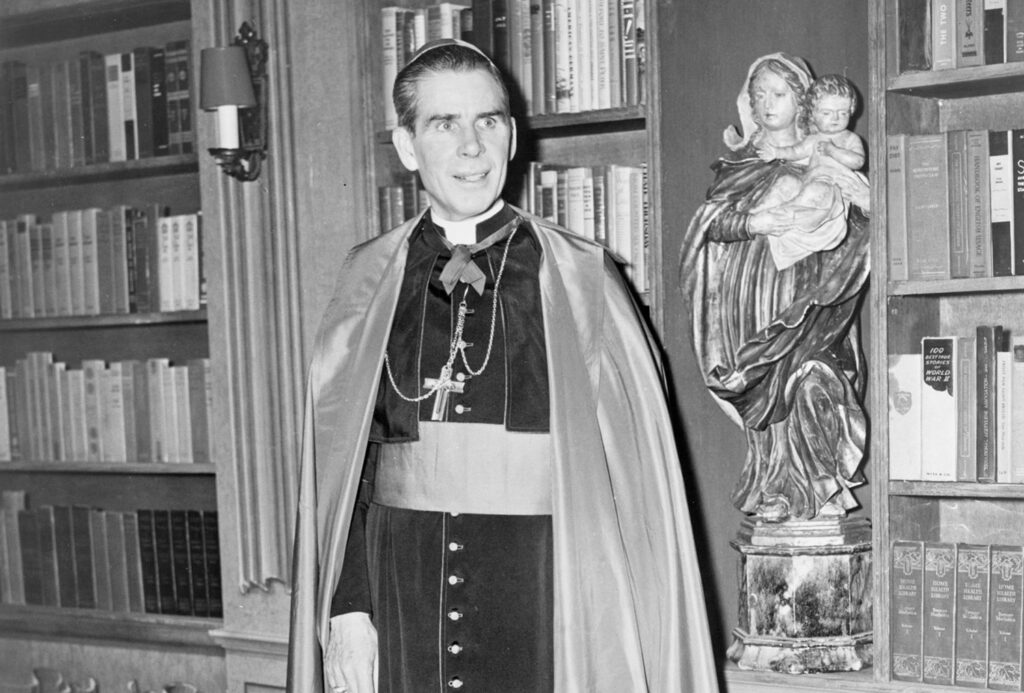
None of that technical mastery would have meant much if the message beneath it had been cold. Sheen’s theological content was often dense, delivered to an audience that included many non-Catholics. What made it land wasn’t simplification, but warmth applied without dilution. He’s widely credited with softening a real current of American anti-Catholic sentiment simply through the manner of his communication.
The broadcast was only half the record. Away from the cameras, Sheen personally instructed converts, including Clare Boothe Luce and Henry Ford II, in private lessons. Luce’s own account, after five months of what she called real argument rather than gentle persuasion, is the clearest evidence that Sheen’s warmth was never a performance. She called him a teacher who could be “at once so patient and yet so unyielding, so poetic and so practical, so inventive and so orthodox.” That is a description of someone who refused to trade conviction for likability and was loved for it anyway.
Why this still matters
Fewer and fewer Americans alive today witnessed Sheen’s screen appearances in real time, yet there is a sense of nostalgia for his charm and what he represented during post-war America. This hardly relegates him to merely a relic of the past, given that his work and example has so profoundly shaped how the Gospel currently travels. What started as a radio show and later TV show opened the doors to today’s YouTube channels, TV channels, websites, and social media accounts that preach the Gospel through our screens. He trailblazed the path we now hike so comfortably.
Sheen will be beatified on Sept. 24 in St. Louis. The miracle that helped clinch his beatification involved a baby born without a pulse suddenly miraculously starting to breathe 61 minutes later. His mother sweetly shared that this was not just a miracle for her and her family; instead, it was a miracle for the Church who needs Bishop Sheen. His life continues to pose the question of our time: How can the screens best carry the gospel? Is the content we are producing worth people’s attention? His content always reminded us that life was worth living, and not simply because of our accomplishments and little luxuries, but because everything is a generous gift from God.
Related Posts

Holistic eating for the busy woman
By Lindsey Fedyk

5 herb plants every kitchen needs (and how to grow them!)
By Jessica Nardi

Entertaining in the ordinary
By Calista Boskus

Fall reading challenge 2026
By Grace Porto