Would the saints go no-contact with their parents?
Published on November 5, 2026
Over the past few years, there have been a number of think pieces on the trend of young adults going “no-contact” with their parents. The trend is exactly what it sounds like — for one reason or another, the adult child decides that he or she can no longer speak to his or her parents, whether in-person, via text or phone call, or through a letter.
Tragically, about a third of adults are estranged from their family. While there are legitimate cases of abuse that require prudent distance, people often cite disagreements over politics, negative comments about sexuality, or even disagreements over personal boundaries as reasons for estrangement.
As Catholics, we have to think critically about this trend. We are called to love and honor our parents, and Our Lord’s example of sacrificial love tells us to love our enemies, to turn the other cheek, and to forgive injuries.
But what about cases of abuse or neglect? Does forgiving your parents always mean staying in contact with them? And does honoring our parents mean obeying their every wish?
None of the saints would have used the language of going “no-contact,” and while some reconciled with their parents, others ran away from home or stopped speaking with their parents for a period of time. Their lives give us a guide for navigating everything from parental tensions to abusive families.
1. Ven. Lucia of Fatima
Venerable Lucia of Fatima was just 9 years old when the Blessed Virgin first appeared to her and her little cousins, Sts. Francisco and Jacinta. Though they were supposed to keep the apparition secret, 6-year-old Jacinta accidentally let the story slip. Jacinta and Francisco’s mother viewed it as a childish fantasy, with their father more inclined to believe them. However, Lucia’s devout but austere mother, Maria Rosa, thought she was lying, and her father, who was a heavy drinker and not overly pious, largely stayed out of the affair.
Throughout the course of the apparitions, Lucia’s mother beat her, demanded she recant the story, and brought her to the village priest, who thought the apparitions might be demonic. It was only after the famous Miracle of the Sun that Maria Rosa believed Lucia. In the meantime, Lucia offered up her suffering for sinners, as Our Lady had asked.
From that point on, the mother and daughter had a closer relationship. While author William Thomas Walsh writes in his book Our Lady of Fatima that “Lucia drew a mantle of charitable silence” over the details of her reconciliation with her mother after the miracle, Maria Rosa took strides to protect her daughter from nosy tourists and well-meaning but intrusive pilgrims, sending her away to a school and keeping in touch through letters.
Lucia shows us that reconciliation and forgiveness are possible, even in the face of intense distress. Even after she had the distance of being a cloistered nun, she was able to keep in touch via letters, and her mother attended her final profession.
2. St. Francis of Assisi
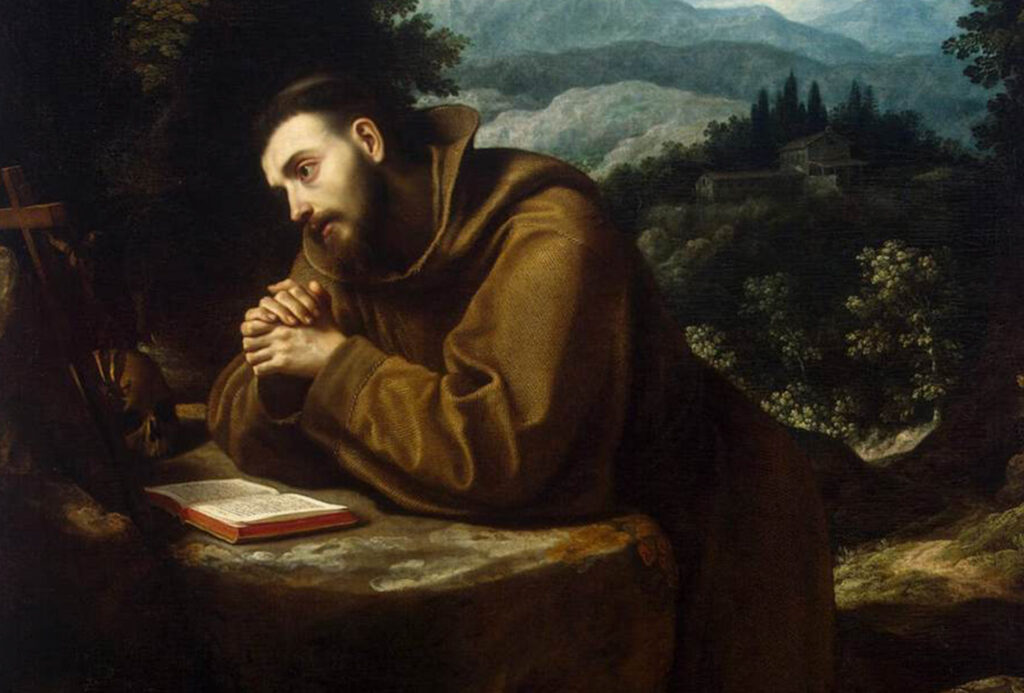
St. Francis was the son of wealthy merchant Pietro di Bernardone, but after he was imprisoned and subsequently became ill in a local battle against the city of Perugia in 1202, he had a deep conversion. A miraculous encounter with Our Lord, who asked St. Francis to rebuild His church, confirmed his faith further, and, taking the exhortation literally, he sold his father’s best silk and tried to use the proceeds to rebuild the church of San Damiano. (The church’s pastor kindly refused the offer.)
When Pietro found out that his son was using his money without asking, he had him beaten and locked in a cellar, which made little impact on Francis. His mother released him from the cellar while his father was away, and he continued rebuilding the church, hiding in a cave. When Pietro returned, he brought his woes before the local bishop, enraged with his son.
When he was before the bishop, Francis said dramatically, stripping off his clothes, “From now on I will say freely: ‘Our Father who art in heaven,’ and not ‘My father Pietro di Bernardone.’ Look, not only do I return his money; I give him back all my clothes. I will go to the Lord naked!”
Some scholars speculate that there was a reconciliation between the two later, but Francis’ story showed us another lesson: Honoring one’s parents does not mean unquestioning obedience and that parents do not have unrestricted authority over their adult children’s lives.
3. St. Clare of Assisi
St. Francis’ contemporary, St. Clare of Assisi, had an even more radical departure from her family to pursue her vocation. Also from a wealthy family, Clare’s parents wanted her to marry a wealthy nobleman, but she was inspired by the preaching of St. Francis to found the Poor Clare Sisters, a cloistered order. She ran away from home one night, and torch-carrying friars met her on the road. In the little chapel of Portiuncula, she received a rough woolen habit, exchanged her jeweled belt for a rope, and let St. Francis cut her long hair, a symbol of her consecration to God. She hid in a Benedictine convent, and when her father and uncles stormed the convent in rage, she removed her veil to show them her shorn head.
St. Clare’s story shows us that once again, sometimes it is necessary to defy one’s parents to embrace God’s will. The fact that she became a cloistered sister also brings up an interesting point for consideration: She didn’t go “no-contact” because she hated her parents or wanted to harm them, but following God’s path for her life required her to resist her parents’ wishes.
4. Bl. Luke Hwang Sŏk-tu
Blessed Luke was the only child of a wealthy noble family in Korea in the early 1800s, when Catholicism was illegal in Korea. While he was traveling studying for a government career, he heard the Gospel, and came home and announced that he was forgoing his academic exam in order to follow Jesus.
Luke’s father was furious and frequently beat his son. When Luke’s wife converted, his father became even more angry, and threatened to murder Luke. Finally, Luke gave up speaking for two years, going completely mute. His parents and family eventually all converted, and Bl. Luke was martyred for his faith in 1866.
Bl. Luke shows us that sometimes strict boundaries, like restricted communication, are necessary to remaining faithful to Christ. In Luke’s case, these boundaries were the path to reconciliation and conversion for his family.
5. St. Dymphna
This Irish saint experienced one of the most extreme cases of parental abuse. Her father was a petty king of Ireland, and when his wife died, he became mentally ill. His counselors urged him to remarry, and he agreed only if he could find somebody as beautiful as his wife. He wanted to marry his daughter, Dymphna, who fled Ireland with her priest. She hid in Belgium, but her father followed them there and killed them both, making her a martyr for purity.
Dymphna’s story shows us that in cases of danger and abuse, safety is of utmost importance. Honoring one’s parents does not mean putting oneself in physical or moral danger, and separation may be necessary for the good of the victim and the abuser.
What about the parents?
Many saints also had to deal with rebellious, difficult, and estranged children. Their examples of patience, perseverance, and faith in God’s mercy offers an inspiring witness for modern parents of difficult children.
Perhaps the most famous of these saintly parents is St. Monica, who prayed for her son Augustine’s conversion for over 10 years. When he first fell into the heresy of Manicheism, she kicked him out of the house and wouldn’t even host him for meals. However, a mystical vision told her that her son would return to the faith, and this convinced her that estrangement was the wrong way to deal with her son. From then on, she offered many prayers and sacrifices for her son.
Augustine continued to live an immoral life, and one day he told his mother he was going to the docks to say farewell to a friend. However, he took a ship from Carthage, North Africa, to Rome. When his mother found out, she followed him there. By the time she arrived in Rome, Augustine had left for Milan, and she followed him there, too.
In Milan, Monica met the bishop, St. Ambrose, who became her spiritual director and was instrumental in Augustine’s conversion. She died shortly after St. Augustine’s baptism.
Saint Monica’s story shows us several things. Sometimes relentlessly pursuing our children, even when they resist us, is how God asks us to witness His mercy. God will listen to our prayers, even if they are not answered on our timeline, and a trusted spiritual advisor (like St. Ambrose) can help us discern how God is asking us to love our children.
Other famous saintly parents of rebellious children include St. Rita of Cascia, St. Elizabeth of Portugal, and St. Matilda. It is worth reading their stories and asking for their intercession as we navigate challenging parent-child relationships.
So can Catholics ever go no-contact?
Through the examples of the saints’ lives, we learn two things: Honoring our parents does mean forgiving them, but forgiveness doesn’t mean blind obedience, continuous communication, or unrestricted access to one’s life. They also show us that sometimes firm boundaries are a path to forgiveness and reconciliation.
Even when physical or emotional distance was necessary, these saints still loved their parents. Forgiving them as Christ forgives, they did not wish evil or hellfire upon them, often praying and sacrificing for their conversion. When navigating difficult family situations, we can call on these saints for the strength, prudence, and charity to know what the situation requires of us.
Related Posts

Memento mori: Why we should think about death
By Rosie Hall

Sage and Garlic Butter Pork Chops
By Calista Boskus