The heartbreaking story behind the best children’s books you’ve never heard of
By Brittany Makely
Published on
April 15, 2026
Graphic by Zeale Staff
This article is part of a Zeale Lifestyle series featuring reviews of classic works of literature from the 1000 Good Books Project, started by a Catholic homeschooling family on a mission to bring an affordable, trustworthy, comprehensive library of audiobooks to families.
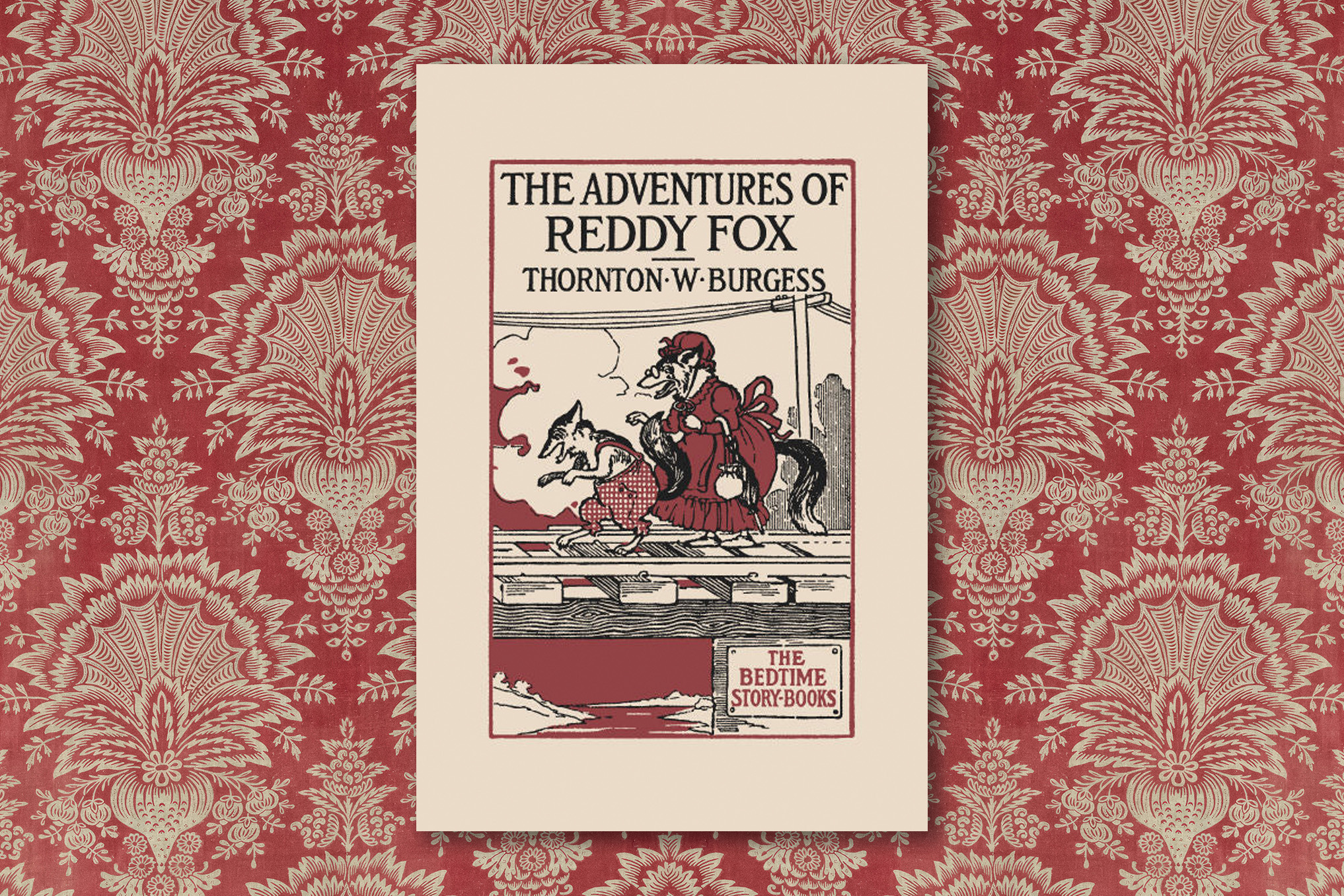
He knew that he had nothing, not the least little thing, to fear from Reddy Fox. So Peter gave a whoop of joy and sprang out into view. Reddy looked up and tried to grin, but made a face of pain instead. You see, it hurt so to move. “I suppose you’re tickled to death to see me like this,” he growled to Peter Rabbit. Now Peter had every reason to be glad, for Reddy Fox had tried his best to catch Peter Rabbit to give to old Granny Fox for her dinner, and time and again Peter had just barely escaped. So at first Peter Rabbit had whooped with joy. But as he saw how very helpless Reddy really was and how much pain he felt, suddenly Peter Rabbit’s big, soft eyes filled with tears of pity. He forgot all about the threats of Reddy Fox and how Reddy had tried to trick him. He forgot all about how mean Reddy had been. “Poor Reddy Fox,” said Peter Rabbit. “Poor Reddy Fox.”
(This excerpt is from The Adventures of Reddy Fox. Click here to listen to a preview!)
Down by the smiling pool, in Cape Cod, Massachusetts, the woods and meadows are full of adventure. Reddy Fox, Johnny Chuck, Jimmy Skunk, and Jerry Muskrat, not to mention Peter Rabbit himself, are some of the characters in Thornton W. Burgess’s wonderful Bedtime Story Books.
These books, included in the 170 that he published from 1910 until his death in 1965, are a forgotten treasure of American children’s literature.
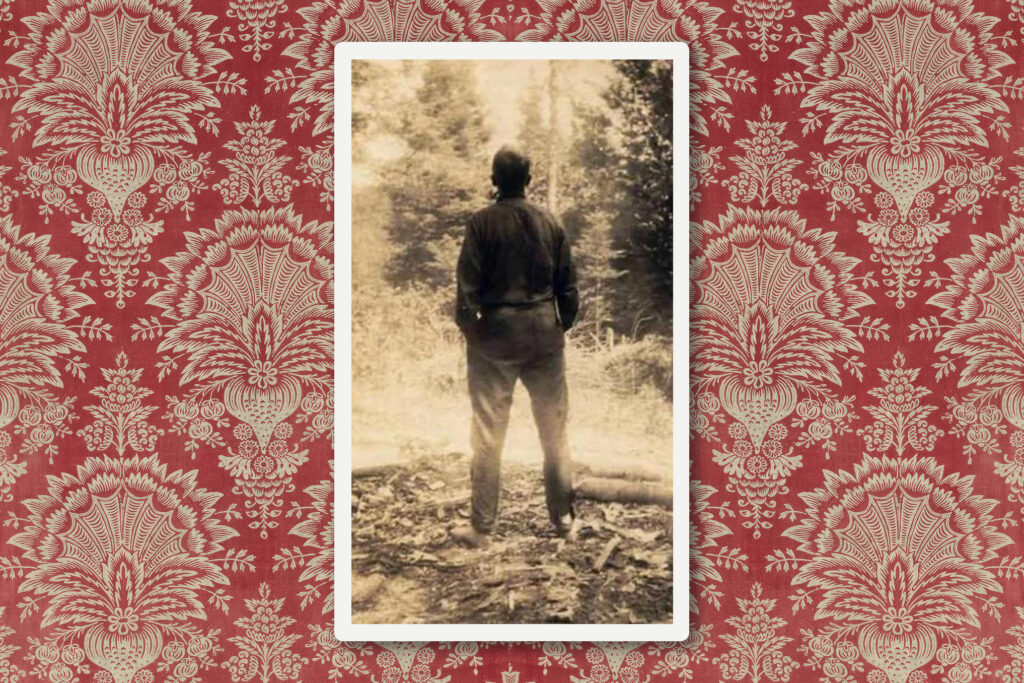
Photograph of Burgess
A naturalist, a father, and a writer
Burgess was born in Sandwich, Massachusetts, and grew up in the woods and wetlands of Cape Cod. He was fascinated by the plants and animals he came to know well and became a life-long naturalist. He left business college after a year because he wanted to write.
He married Nina Osborne when he was 31 years old. In 1906, Nina tragically died during childbirth with their son, leaving Burgess alone to raise their son.
In the next few years, he began a nightly habit of telling his son stories about animals to help him fall asleep at bedtime. At the age of five, Burgess’ son went to Chicago to visit his grandmother. By then the boy had grown so attached to the stories that Burgess mailed one each day, so that his grandmother could read them at bedtime. Those stories were saved, and then eventually submitted to a publisher and ultimately printed as Old Mother West Wind. Around the same time, Burgess began writing a syndicated column that resulted in 15,000 stories, many of which were collected into his 170 books.
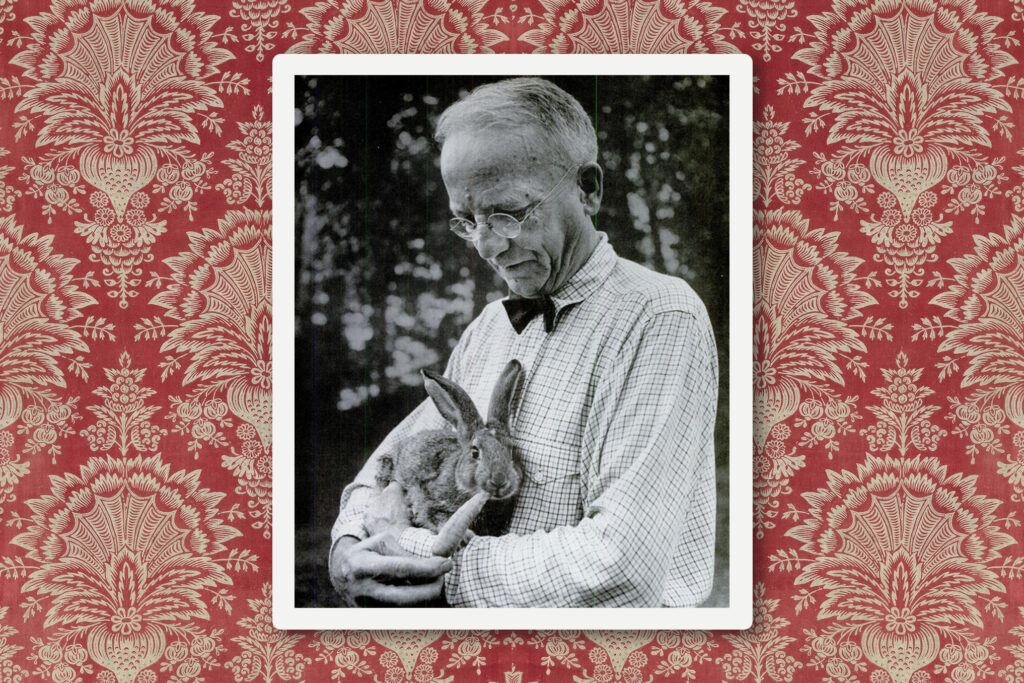
Thornton W. Burgess, Life Magazine, Aug 28, 1944
Stories with a heart
Burgess’s stories involve simple, wholesome characters and explore virtues, vices, and practical wisdom in the tradition of animal fables hearkening all the way back to Aesop. He draws on that tradition, especially the stories of Uncle Remus and Beatrix Potter. In fact, although he spontaneously thought of the name “Peter” for his central rabbit character, he acknowledged the obvious predecessor, explaining: “I like to think that Miss Potter gave Peter a name known the world over, while I with Mr. Cady’s help perhaps made him a character.”
The central theme of his books, though, was not primarily didactic. His main goal was to impart in his readers a love for animals. He carefully conformed his characters to the quirks and characteristics of the real animals he knew so well. A child will come away from his books not just with the satisfaction of a well-told story, or the edification of a moral fable, but with a better imaginative portrait of a panoply of animals interacting in their natural habitat. Burgess took this realism to heart. In one of the stories he wrote that Chatterer the Red Squirrel stole corn from a crib and hid it. During an interview with writers from the New Yorker he explained: A man in Ohio called this nonsense and said that the red squirrels on his place never did such things. Burgess asked him for more details. “And just as I thought,” he told us, “they weren’t red squirrels at all but a red variation of the gray squirrel.” Old Mother West Wind knows best.
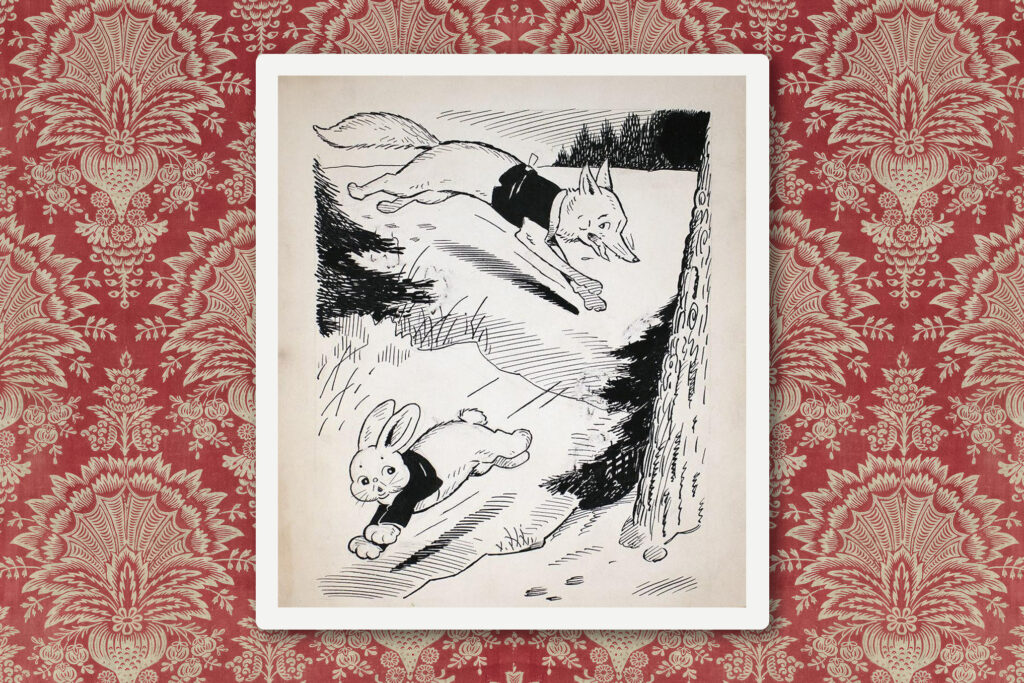
Reddy Fox and Peter Rabbit, original illustration by Harrison Cady, Thornton W. Burgess Society
The Thousand Good Books
Thornton W. Burgess’ books are a favorite of the Thousand Good Books Project. The Burgess collection and many other classics, including Aesop’s Fables, Winnie the Pooh, the Just So Stories, Tom Sawyer, Alice in Wonderland, Treasure Island, The Secret Garden, The Wind in the Willows, Sherlock Holmes, the Call of the Wild, The Three Musketeers, Sense and Sensibility, The Great Gatsby, A Tale of Two Cities, and others are being reintroduced to families through the efforts of the Thousand Good Books Project. Their affordable, trustworthy, comprehensive library of audiobooks is inspired by Professor John Senior’s list of what he termed the “thousand good books.” The 1000 Good Books Project hopes to give families the resources to form the minds and hearts of the next generation with the classic literature of the past. Check them out and see if audio books can be a window into a larger world of literature for you and your family!